Updated guidance has been issued from IATA regarding the specification of Hazard Labels, the information can be found here


Specialist Instructors & Consultants for the Transport of Dangerous Goods
Updated guidance has been issued from IATA regarding the specification of Hazard Labels, the information can be found here

To assist shippers in understanding the complete requirements related to the transport of lithium batteries, including packing instructions, IATA has prepared the Lithium Battery Shipping Guidelines (LBSG).
Download the updated Guidance Document (pdf) to learn how to comply with the 59th (2018) Edition of the IATA Dangerous Goods Regulations (DGR) on definitions, classification, exceptions, prohibitions. It also includes FAQs.
Following a growing number of requests regarding the changes to the IATA Dangerous Goods Regulations (DGR) for lithium batteries in 2017, IATA has prepared a Guidance Document that addresses the use and carriage of lithium battery-powered devices such as cargo tracking devices and temperature data loggers.
The guidance document also provides information to manufacturers of these active devices, users of the active devices and operators that must approve the carriage of active devices in cargo.
Download the Guidance Document – Battery Powered Cargo Tracking Devices / Data Loggers (pdf)
The Addendum to the 59th Edition of the DGR contains clarification on operational considerations to the provisions for the handling of baggage equipped with lithium batteries, other than lithium button cells. The addendum also contains new and modified state and operator variations. The eDGR auto-update will also be available shortly. These changes are effective as of 1st of January, 2018 except the changes in Table 2.3.A and 2.3.5.9, which become effective 15th January 2018.
Click here: English .pdf
Summer isn’t even over yet and IATA have published their Significant Changes to the 59th Edition of the IATA Dangerous Goods Regulations 2018. These can be found on the IATA website here.

IATA have issued updates to to Operator Variations for the 58th (2017) Edition of the Dangerous Goods Regulations, they can be found here

To assist shippers in understanding the complete requirements related to the transport of lithium batteries, including packing instructions, IATA has prepared the Lithium Battery Shipping Guidelines (LBSG).
Download the updated Guidance Document (pdf) to learn how to comply with the 58th (2017) Edition of the IATA Dangerous Goods Regulations (DGR) on definitions, classification, exceptions, prohibitions. It also includes FAQs.
The 58th Edition is effective 1 January 2017. View the Significant Changes in DGR 58 (pdf). You could also find an overview of the changes provided by IATA’s subject matter experts here.
On 22 February the ICAO Council adopted the recommendation of the ICAO Air Navigation Commission (ANC) that lithium ion batteries, UN 3480, Packing Instruction 965 only, be forbidden, on an interim basis, as cargo on passenger aircraft. The prohibition does not apply to lithium ion batteries packed with equipment or lithium ion batteries contained in equipment, UN 3481, Packing Instruction 966 and Packing Instruction 967 respectively.
The prohibition becomes effective 1 April 2016, as applies to the requirements that lithium ion batteries, UN 3480, PI 965, to be shipped at a state of charge of no more than 30% of their rated capacity, and other changes advised through the addendum to the 57th edition of the IATA Dangerous Goods Regulations (DGR) issued in January of this year.
A further addendum to the DGR will be issued later this week to align with the issuance of Addendum 4 to the ICAO Technical Instructions.
The full release can be found here
***UPDATE**** on the 26th February 2016 IATA posted Addendum II to the 57th DGR which incorporates the above announcement. The full addendum can be download here
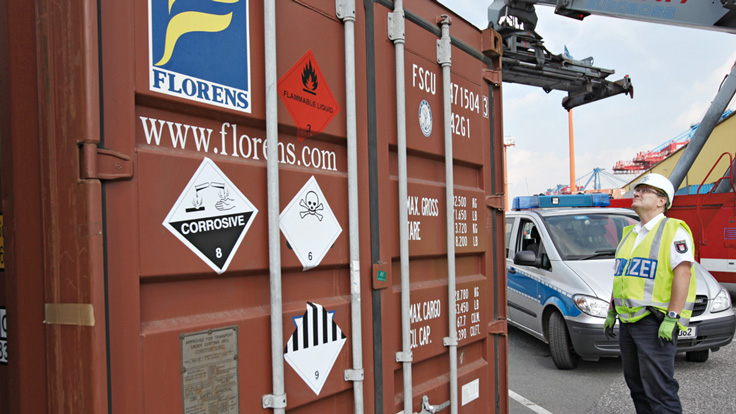
Hapag-Lloyd has announced that it registered 65% more incorrectly declared dangerous goods in 2015 than in 2014.
The carrier uses a special safety software to continuously check cargo data to identify anything conspicuous. In 2015, this software identified 4,314 cases of incorrectly declared dangerous goods, compared to 2,620 in 2014.
Ken Rohlmann, head of the carrier’s dangerous goods department, said one reason for this increase was an increase in the volume of cargo shipped by Hapag-Lloyd after its merger with CSAV.
The second reason, he said, was the fall-out from the explosion of dangerous goods at the Port of Tianjin in mid-August. “Many ports drastically tightened their dangerous goods guidelines in the wake of the incident or even prohibited dangerous goods from being processed at all,” he said.